
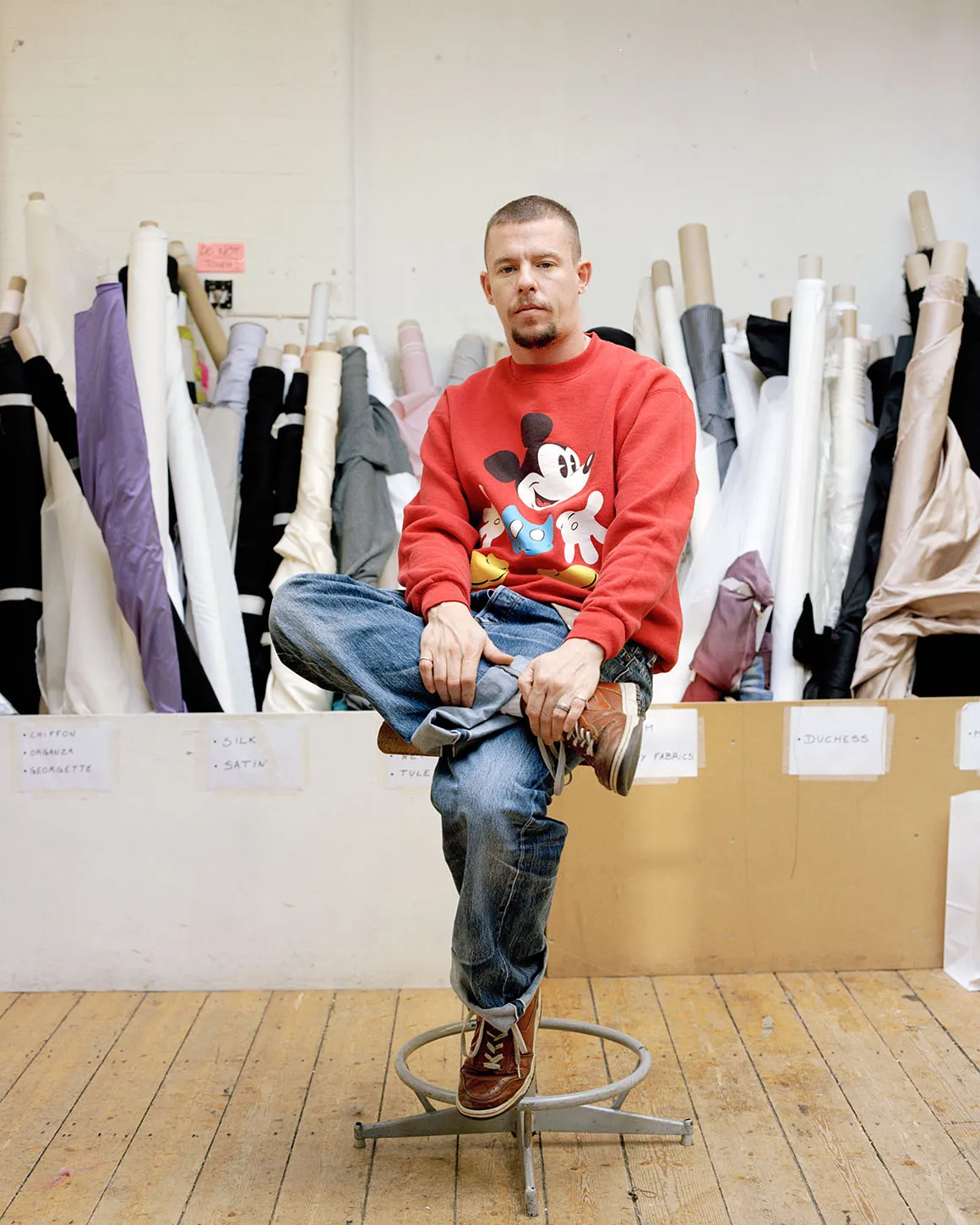

Updated November 23, 2026. We rewrote this portrait from 2024 and added the latest developments at the house, including the departure of Seán McGirr.
Few designers have managed to frighten, seduce and move an audience in the same ten minutes. Lee Alexander McQueen did it season after season. More than fifteen years after his death, the house that carries his name is still measured against him, and in autumn 2026 it is once again searching for someone who can live up to that.
Who was Alexander McQueen?
Lee Alexander McQueen was born in London in 1969, the youngest of six children of a taxi driver. He left school at 16 and learned tailoring on Savile Row, first at Anderson & Sheppard, then at Gieves & Hawkes, before working for the theatrical costumier Angels and Nathans and for Romeo Gigli in Milan. That craft training remained the base of everything he did: no matter how theatrical the show, the cut was precise.
His 1992 graduate collection at Central Saint Martins was bought in its entirety by the stylist Isabella Blow, who became his mentor and champion. Within a few years he was the enfant terrible of London fashion, famous for the low-slung “bumster” trousers and for collections such as Highland Rape (1995), which confronted English romanticism about Scotland with its violent history.
His most important accomplishments
In 1996, at only 27, McQueen became chief designer at Givenchy in Paris, a post he held until 2001. In 2000 the Gucci Group, today Kering, acquired a majority stake in his own label, which allowed it to grow into a global luxury house. He was named British Designer of the Year four times and received a CBE in 2003.
His shows were events. In No. 13 (spring 1999) the model Shalom Harlow stood on a turntable while two industrial robots spray-painted her white dress. In 2006 a hologram of Kate Moss floated inside a glass pyramid. And Plato’s Atlantis (spring 2010), with its reptile prints and the towering armadillo shoes, was one of the first major fashion shows streamed live online. McQueen understood earlier than most that fashion could be performance, film and commentary on society at the same time.
Death and legacy
McQueen died in February 2010 at the age of 40, days after the death of his mother. The exhibition Savage Beauty at the Metropolitan Museum of Art in New York in 2011 and at the V&A in London in 2015 became one of the most visited fashion exhibitions ever and cemented his status as an artist as much as a designer.
His long-time right hand Sarah Burton took over as creative director and led the house for 13 years. Her best-known design was the wedding dress of Catherine Middleton in 2011. In October 2023 the Irish designer Seán McGirr, previously head of ready-to-wear at JW Anderson, succeeded her.
McQueen in 2026: a house in transition
McGirr returned repeatedly to the founder’s codes, from bumster trousers to the skull scarf. His autumn/winter 2026 collection, inspired by Todd Haynes’ film Safe, dealt with the pressure of constant self-presentation on social media. In September 2026 he took the brand back to London Fashion Week for the spring/summer 2027 collection, its first official show in the city since 2001.
Only weeks later, on October 15, 2026, Kering announced that McGirr would leave after three years. The house is in the middle of a strategic reset: Kering plans to halve McQueen’s store network by the end of 2026 compared with the end of 2025. At the time of writing, a successor had not been named. Whoever takes over inherits one of the clearest brand identities in fashion and one of the heaviest expectations.
What the brand stands for
McQueen’s values can be summed up in a few contrasts: precise tailoring and raw emotion, beauty and brutality, British tradition and rebellion against it. The house has always been at its best when it was uncomfortable. That is the real challenge for every designer who follows Lee McQueen: not to copy his drama, but to find something that matters as much today as his shows did in the 1990s.
Key facts at a glance
- Born: 1969 in London, died February 2010
- Training: Savile Row tailoring, MA at Central Saint Martins (1992)
- Career highlights: chief designer at Givenchy 1996 to 2001, British Designer of the Year four times, CBE 2003
- Creative directors after him: Sarah Burton (2010 to 2023), Seán McGirr (2023 to 2026), successor not yet named in November 2026
- Owner: Kering (formerly Gucci Group) since 2000
Frequently asked questions
Who was Alexander McQueen?
Lee Alexander McQueen (1969 to 2010) was a British fashion designer trained on Savile Row and at Central Saint Martins. He founded his own label, was chief designer at Givenchy from 1996 to 2001 and became known for theatrical shows and precise tailoring.
What were Alexander McQueen’s main accomplishments?
He was named British Designer of the Year four times, received a CBE in 2003, led Givenchy as chief designer and created landmark shows such as No. 13 and Plato’s Atlantis. The exhibition Savage Beauty became one of the most visited fashion exhibitions ever.
Who is the creative director of McQueen?
Seán McGirr led the house from 2023. Kering announced his departure on October 15, 2026. A successor had not been named at the time of writing.
Sources
- McQueen creative director Seán McGirr exits after three years (Retail Gazette, October 2026)
- Seán McGirr departs McQueen (Vogue Scandinavia)
- McQueen AW26 was a Hollywood horror show (Dazed)
- Alexander McQueen returns to London Fashion Week (TheIndustry.fashion, September 2026)
- Seán McGirr exits McQueen (Business Today, October 2026)
This article was updated with AI assistance and is based on the sources listed.